World Flags: A Bold Display Typeface for Global Campaigns
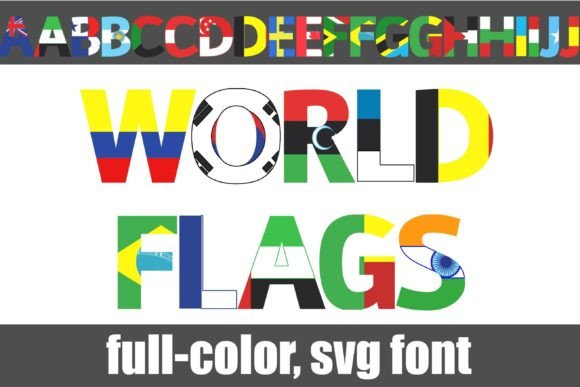
If you’ve ever scrolled past a social feed and paused—just for half a second—because a headline *popped* with unexpected color, texture, and cultural resonance, you know the power of a well-chosen display font. World Flags isn’t just another decorative typeface. It’s a full-color OpenType-SVG font built for impact: massive, extra-thick block letterforms where each glyph is uniquely masked with vibrant national flag patterns. Think “bold headline” meets “instant geographic storytelling”—all in one scalable, vector-based color font.
This isn’t a font for body copy or long-form captions. World Flags thrives where attention is scarce and meaning must land instantly: YouTube thumbnails, Instagram Reels covers, Pinterest pins, email headers, digital ad banners, and limited-edition campaign visuals. Its visual personality is confident, inclusive, and globally aware—ideal for brands launching international services, celebrating cultural moments, or building community around shared values.
Readability on mobile and small previews is non-negotiable—and World Flags delivers precisely because it’s designed for scale and contrast. The thick letterforms hold up even at 48px on a 320px-wide mobile thumbnail. The embedded flag textures don’t blur or pixelate; they render crisply across iOS, Android, and modern web browsers that support OpenType-SVG. That means your “Summer Sale Starts Now” banner stays sharp whether it’s viewed on a TikTok feed or pinned to a Shopify homepage.
Use World Flags to anchor hierarchy—not compete with it. Pair it with a clean sans serif like Inter or Montserrat for subheadings and body text. That contrast gives your message structure: the display font commands attention, while the supporting type ensures clarity and scannability. For editorial-style campaigns (think newsletters or blog headers), try pairing it with a restrained serif like Lora or Playfair Display—adding sophistication without sacrificing energy.
Real-world use cases show its strategic flexibility:
- Sale announcements: “50% OFF WORLDWIDE” in World Flags, backed by a gradient sky background and a minimalist sans-serif CTA button—immediately signals inclusivity and urgency.
- Product teasers: A single word—“LAUNCH”—in World Flags, centered over a blurred globe map, builds anticipation before revealing details.
- Inspirational quote graphics: “Borders are drawn in ink. Courage is written in action.” Set the first line in World Flags, the second in a light-weight sans serif—creating emotional weight followed by quiet resolve.
- Webinar banners: “Global Design Trends 2024” uses World Flags for the year (“2024”) only—turning numerals into subtle cultural anchors without overwhelming the message.
- Branded content series: A recurring Instagram carousel titled “Flag Stories” uses World Flags consistently for the series name across all posts—reinforcing recognition faster than any logo mark could.
It works best for short, high-impact text: headlines under six words, callouts (“NEW”, “LIMITED”, “JOIN”), logo marks (when used as a stylized wordmark), and decorative accents like bullet points or divider lines in presentation decks. Avoid stacking multiple lines of World Flags—its strength lies in singularity, not density.
Audience perception shifts quickly when typography carries intention. A brand using World Flags signals openness, diversity, and global fluency—not through stock imagery or clichéd slogans, but through deliberate, visible design choices. In product launches, it adds gravitas. In seasonal promotions (like International Women’s Day or Pride Month campaigns), it grounds messaging in authenticity rather than tokenism. For personal branding—especially for creators, consultants, or educators with international audiences—it communicates credibility and cultural fluency before a single word is read.
Because World Flags is a color font, it behaves differently than traditional fonts in some environments. Confirm compatibility before deploying: it renders natively in Adobe Creative Cloud apps (Photoshop, Illustrator, After Effects), Figma (with SVG font plugins), and modern browsers—but may fall back to monochrome in older email clients or unsupported CMS editors. Always test export formats when building templates for client work or digital products.
Licensing matters—especially for marketers. World Flags is a premium font, and commercial use requires appropriate licensing. If you’re embedding it in client-branded Canva templates, selling branded merch with the font, or using it in paid ads served across Meta or Google platforms, verify the license covers those use cases. Most foundries offer clear tiered options (personal, standard commercial, extended), so review terms before scaling usage across campaigns.
As a marketing specialist who builds scroll-stopping visuals daily, I reach for World Flags when the goal isn’t just visibility—but resonance. It transforms static text into a visual handshake across cultures. It turns campaign headers into mini statements of intent. And it does so without sacrificing technical reliability or typographic discipline.
In an era where digital fatigue is real and attention spans shrink by the quarter, tools like World Flags aren’t decorative extras—they’re strategic assets. When every pixel competes for trust, a font that communicates inclusion, confidence, and clarity—without saying a word—isn’t just smart design. It’s sound marketing.